
Reconstruction-Era Black Self-Governance (1865–1877)
Reconstruction shows a truth rarely taught: multiracial democracy existed in America—and it was deliberately rolled back. The evidence remains in the records.
6/7/20261 min read
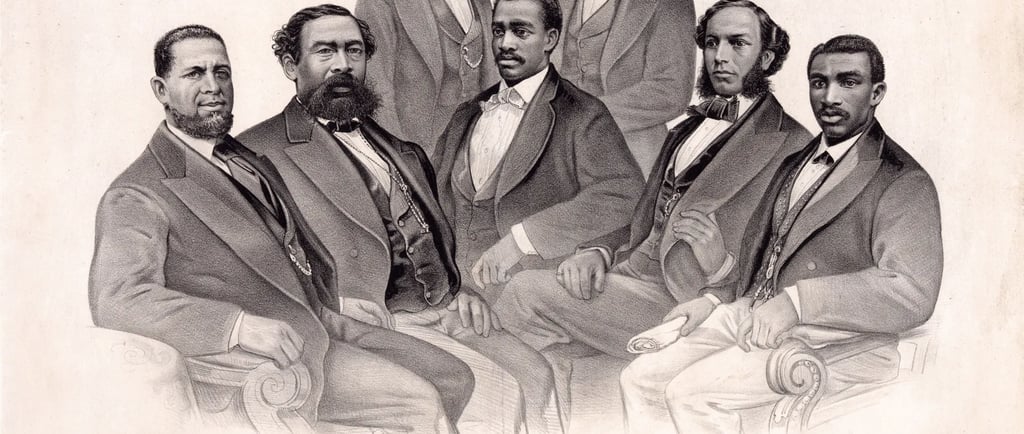
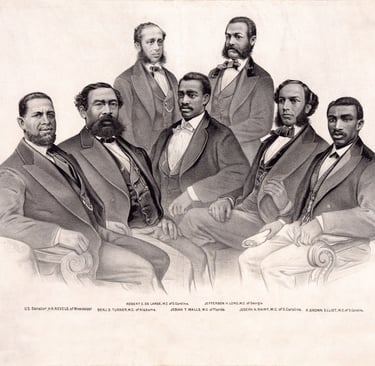
Reconstruction-Era Black Self-Governance: America’s First Multiracial Democracy
In the years following the Civil War, the United States experienced a brief but transformative period known as Reconstruction (1865–1877). During this time, formerly enslaved Black Americans did far more than gain the right to vote—they governed. Across the South, Black citizens held public office at nearly every level, building the first experiments in multiracial democracy in American history.
More than 2,000 Black men served in elected or appointed positions during Reconstruction. They included local sheriffs, judges, tax assessors, state legislators, and members of Congress. Communities such as Grant Parish, Louisiana; Wilmington, North Carolina; and counties throughout South Carolina and Mississippi were governed by interracial coalitions led largely by Black officials who were newly enfranchised under the Reconstruction Amendments.
The historical record is clear. Congressional rosters, state legislative journals, and local election records document Black governance in counties and towns across the former Confederacy. These officials helped establish public school systems, expand voting access, rebuild infrastructure, and write more inclusive state constitutions—many of which laid the groundwork for modern public education and civil rights protections.
Yet this era is often minimized or framed as a failure. Why? Because it was violently overthrown. White supremacist groups used intimidation, massacres, and targeted assassinations to dismantle Black-led governments. At the same time, Supreme Court decisions—such as United States v. Cruikshank (1876)—weakened federal enforcement of civil rights, allowing states to abandon Reconstruction without consequence.
Reconstruction did not fail due to incompetence. It was destroyed.
Understanding Black self-governance during Reconstruction reshapes American history. It reveals that democracy was expanded—and then deliberately rolled back. The evidence survives in court records, legislative archives, and federal documents. What was erased was not the truth, but the telling of it.